A Road Trip in the Canary Islands Costs Half What You'd Pay in Europe – Here's Why That Changes Everything
Updated: Jun 25
Not long ago I pulled into a gas station on a perfectly ordinary afternoon. The kind of stop that could have happened anywhere in Europe: Berlin, Paris or Milan. I drive a small Smart fortwo, a compact city car with a fuel tank of roughly forty litres. That day the tank was almost empty, so I let the pump run until it clicked. 36 litres. The receipt printed: 73.47 euros.
Seventy-three euros for a Smart.
Holding that receipt, the number felt oddly familiar. In the 1990s, my parents used to fill up cars like a Fiat Croma or a Volvo 850 for similar money before long family road trips. Those were big touring cars. Standing there in 2026, paying almost the same for a tiny city car felt surreal. And it instantly reminded me of a gas station I had visited just weeks earlier on the Canary Islands.

Fuel Prices in the Canary Islands: a Different World
A few weeks before that Berlin stop I was driving across Tenerife, following one of those winding island roads that make the journey part of the destination. Somewhere between a small coastal village and the next viewpoint I pulled into a DISA station, the local fuel network you see all across the islands. Then I looked at the price board.
Diesel: 0.98 euros per litre. Petrol: around 1.00 euro.
For a moment I honestly thought I had misread it. One euro per litre. Not two. Not 1.80. Just one. It felt like stepping into a small time portal back to the early 2000s. The kind of prices you remember from student years, when twenty euros in the tank could carry you through an entire week of driving.
And the surprising part? It happened less than two months ago, in the year 2026.
The Numbers Side by Side
Put them next to each other and the contrast becomes striking.
In much of Central Europe in 2026, petrol often hovers around 2.00 to 2.40 euros per litre. That has quietly become the new normal across Germany, France, Italy and the Netherlands.
In the Canary Islands, petrol frequently sits around 1.00 euro per litre. In practical terms that means fuel on the islands can be more than 50% cheaper than on the European mainland. Or in travel language: for the price of one tank in mainland Europe, you can fill almost two and a half tanks in Tenerife or Fuerteventura.
That difference may sound abstract on paper. On the road, it changes everything.
Why Is Fuel So Cheap in the Canary Islands?
The reason sits in a detail many travellers overlook. The Canary Islands operate under a special tax system within Spain and the European Union. Instead of the typical VAT levels of 19 to 23%, the islands apply a local consumption tax called IGIC, which sits at roughly 7%.
That single difference ripples through everyday life. Groceries are cheaper. Restaurants are more affordable. Daily costs are noticeably lighter. And fuel follows the same pattern.
Because the islands are treated as a special economic region, taxes on petrol and diesel remain significantly lower than on the mainland. The result is a destination that combines spectacular nature with surprisingly reasonable day-to-day costs..
Why This Matters for a Campervan Road Trip
For anyone doing a road trip in the Canary Islands in a campervan, fuel prices are not just a small detail. They shape the rhythm of the entire journey.
When petrol is expensive, every detour becomes a calculation. Do we really drive up that mountain road? Is that viewpoint worth the extra kilometres? Maybe we skip the hidden beach today.
When fuel costs roughly half as much, the mindset shifts completely. Driving becomes spontaneous again. Curiosity replaces calculation. A road that looks interesting becomes a reason to turn the wheel. That is exactly the moment where vanlife starts to feel the way it was always supposed to.
No Calculations, Just Driving
In a single day in Tenerife you can wake up near the ocean, drive through ancient lava fields, cross pine forests in the mountains and watch the sunset from a cliff above the Atlantic. In Fuerteventura you can move from volcanic desert to turquoise lagoons to open dunes, all within a few hours.
The islands are compact enough that exploration never feels exhausting, yet diverse enough that every route reveals something new. And when fuel costs around one euro per litre, those spontaneous detours stop feeling like decisions and start feeling like the natural thing to do.
Tenerife and Fuerteventura: The Best Islands for a Canary Islands Road Trip
Few places in Europe are as well suited for campervan travel as the Canary Islands. The distances are manageable, the roads wind through scenery that feels cinematic and the climate keeps conditions comfortable year-round. Four to five hours from most European cities, yet the landscape feels genuinely remote.
Tenerife
Volcanic, vertical and endlessly varied. A road trip in Tenerife moves from subtropical coastline to pine forest to the lunar terrain of Teide National Park, all within driving distance of each other. The north is lush and dramatic. The south opens wide over the Atlantic. The mountain roads in between connect two completely different versions of the same island.
Fuerteventura
Flat, open and built for driving. Fuerteventura has a different pace: wide roads, long horizons, beaches that stretch for kilometres without a crowd. The north coast around Corralejo and El Cotillo is one of the best vanlife areas in the whole archipelago. The Jandia Peninsula in the south rewards anyone willing to take the unpaved road.
The Campervan Advantage
Modern vanlife is no longer just about minimalism. Many travellers discovering the freedom of campervan journeys today are couples, remote workers or families who value both comfort and independence. A premium campervan covers the gap between the two: a comfortable bed, a compact kitchen, a private bathroom and large windows designed for exactly the kind of landscape the Canary Islands offer.
When fuel prices stay reasonable, the campervan becomes more than transport. It becomes a moving basecamp that follows the light, the wind and whatever road looks interesting next.
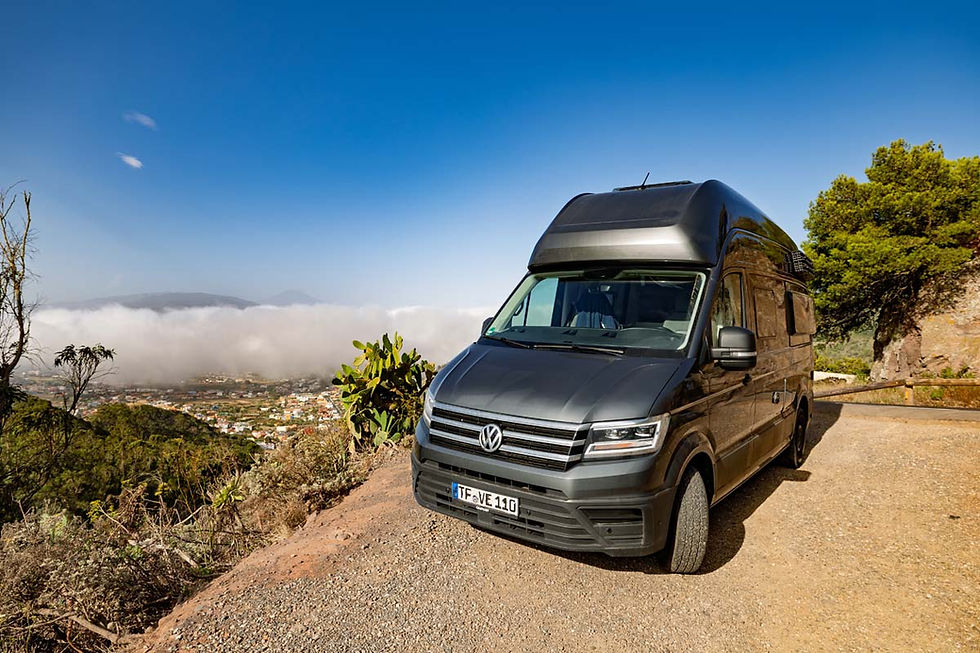
The vanXcapes fleet includes fully equipped campervans across both islands, from the classic VW California 6.1 Ocean to the spacious KNAUS Van TI Plus 700 LF with panoramic windows. All set up and ready to go, so the only thing left is deciding which direction to drive first.
One road. One tank. One euro per litre.
The Canary Islands road trip does not need much more than that.
vanXcapes – for vansation seekers.


Comments