Campervan Rental Tenerife: Complete Guide and 7-Day Itinerary

Tenerife is the most varied island in the Canary archipelago — and the one most people barely scratch the surface of. They land in the south, settle into a resort between Costa Adeje and Los Cristianos, and leave a week later having seen a fraction of what the island actually is.
The best way to see Tenerife properly is a campervan rental. No fixed base. No transfer timetables. No alarm call for the breakfast buffet. You wake up where you parked the night before, and you move on when you are ready.
This guide covers everything you need to plan your campervan rental in Tenerife: how long to stay, what to see, where to sleep and which model fits your trip.
How Long Do You Need to Explore Tenerife by Campervan
Tenerife is compact — roughly 80 kilometres from north to south — but deceptive. The diversity of landscape means that distances take longer than the map suggests. A road that looks like 30 kilometres can take 45 minutes through mountain hairpins.
With 5 days you can cover the main highlights if you keep moving. With 7 days you can explore properly without watching the clock. With 10 days you can slow down, go back to places you liked and spend an afternoon at a beach because you feel like it.
The itinerary below is built for 7 nights, with notes on what to cut if you have less time.
Campervan Rental Tenerife: Day by Day Itinerary
Days 1 and 2: El Médano and the South Coast
Pick up your campervan at Tenerife South Airport and head east. El Médano is your first stop, 15 minutes from the terminal and as far from the resort atmosphere of Los Cristianos as you can get in that time.
El Médano is Tenerife's kitesurfing capital. The wide bay, Montaña Roja rising at one end and the open Atlantic beyond, is one of the most visually striking beaches on the island. In the afternoon the bay fills with kites and sails. By evening the village has a quiet, local character that surprises first-time visitors.
La Tejita, the beach on the opposite side of Montaña Roja, is wilder and less visited. An easy 20-minute walk from El Médano, it rewards the effort with space and silence.
Use day 2 to explore the south at your own pace. Las Galletas, a small fishing village nearby, has some of the best seafood restaurants on this part of the coast. Los Abrigos is similar. Avoid the main tourist strip between Los Cristianos and Las Américas — there is nothing there that needs a campervan.
Where to sleep: Camping Montaña Roja, right beside El Médano beach. One of the best-positioned campsites in the Canaries. Electrical hookups, showers, direct beach access.
Day 3: Up to Teide
This is the day that changes the trip. Drive north from El Médano through the centre of the island into Teide National Park, and within an hour you are in a completely different world.
The road climbs through pine forest into the Las Cañadas caldera, a volcanic crater 17 kilometres wide. The landscape inside is bare, dark and completely unexpected. Lava formations, rock towers and the summit of Teide at 3,718 metres above sea level, the highest point in Spain.
Spend the afternoon walking the trails inside the caldera. The Roques de García loop is the most iconic: an easy 3-kilometre circuit around the most dramatic rock formations, no permits needed. The Teide cable car takes you to 3,555 metres if you want the summit view — book well in advance as places are limited.
Get up early the next morning. The sunrise at Teide, before the coach groups arrive from the south, is one of the most extraordinary landscapes in Europe. Watching the shadow of the volcano stretch across the sea of clouds below is worth waking up for.
Where to sleep: Teide National Park has 13 free forest campsites distributed across the caldera and surrounding pine zone. Booking is mandatory and free, through the Cabildo de Tenerife reservation system. Book as early as possible — they fill up fast.
Day 4: La Orotava and the Lush North
Descend from Teide on the northern slope. The contrast is immediate and dramatic. Pine forest gives way to dense laurel, the temperature drops, mist appears. Within 30 minutes of the volcanic landscape you are in La Orotava.
La Orotava is one of the most beautiful towns in the Canary Islands. The colonial architecture, the terraced gardens and the views down the valley towards Puerto de la Cruz are worth a slow morning. The old quarter is compact and well preserved. Avoid the main tourist road into Puerto de la Cruz and instead follow the backroads through the banana plantations down to the coast.
Puerto de la Cruz itself is Tenerife's oldest resort, with an entirely different character from the south. The Lago Martiánez, a series of seawater pools designed by César Manrique, is worth the entrance fee. The town beach, Playa Jardín, is small but well maintained with black volcanic sand.
Continue west towards Garachico in the late afternoon. The road along the northern cliffside is one of the most scenic drives on the island.
Where to sleep: informal stopping areas above Garachico, or use Camping Nauta in Santa Cruz if you prefer a formal campsite.
Day 5: Garachico and the Northwest Coast
Garachico was once Tenerife's most important harbour town, until a volcanic eruption in 1706 destroyed most of it and created the coastline you see today. The lava flow that buried the old port left behind a series of natural tidal pools, El Caletón, carved into the black rock. They are free to swim in and, on a calm morning, one of the most beautiful places on the island.
The town itself repays a slow exploration. The 16th-century castle, the convent, the cobbled main square and the views from the clifftop gardens above. There is an unhurried quality to Garachico that is hard to find elsewhere on Tenerife.
From Garachico head south to Masca. The road is narrow, winding and the most dramatic on the island. Masca is a small village clinging to a ravine in the Teno massif, surrounded by volcanic rock walls that drop to the sea. Arrive before midday to beat the tour buses. The walk down through the Masca gorge to the coast and back takes around 4 hours: challenging but exceptional.
Continue to Los Gigantes and the giant cliffs, which fall 600 metres straight into the Atlantic. The late afternoon light on the rock face is best seen from the boat trips that depart from the harbour — worth an hour of your time.
Where to sleep: stopping areas near Buenavista del Norte, the quiet town at the far northwest tip of the island. Alternatively head back towards the Teide pine zone.
Day 6: The Anaga Mountains
Save the northeast for near the end of the trip. The Anaga Rural Park is the forgotten part of Tenerife, and in many ways the most extraordinary.
The Anaga is a deeply eroded mountain range covered in laurisilva, a subtropical forest that has survived here since the Tertiary period. Mist drifts through it even on clear days. The villages, Taganana, Afur, Roque Negro, look barely changed from decades ago. The roads are narrow and often single-track, so avoid taking the largest models into the deepest parts.
The viewpoint at El Bailadero gives you the first view of the Anaga from above and explains immediately why this place is different from the rest of Tenerife. From there, the road drops into the forest and the world closes in around you.
Taganana, at the end of the main road through the range, has a beach of black volcanic sand and a handful of bars and restaurants. The pace is slower than anywhere else on the island.
On the way back, stop at Playa de las Teresitas just outside Santa Cruz. It is the only imported sand beach on the island, golden, sheltered, with a backdrop of palms and the Anaga ridgeline above. Good for a late afternoon swim.
Where to sleep: Camping Nauta in Santa Cruz is close and well equipped. The only formal campsite in the capital area.
Day 7: Return South
Use the last day to move back towards the south at a relaxed pace. The TF-1 motorway is the fast route. The coastal road through Candelaria and Güímar is slower and more interesting.
Candelaria is an important pilgrimage site with a large basilica and the famous bronze statues of the Guanche kings facing the sea. Worth a stop even if you have no particular interest in religious sites — the setting is unusual and the seafront has a calm, local atmosphere.
Return the van at Tenerife South Airport on day 8, or earlier if you need to catch an afternoon flight.
What Not to Miss on Your Campervan Rental in Tenerife
Teide at sunrise is the reason to book the national park campsite early. The shadow of the volcano across the sea of clouds below is something that photographs cannot fully capture.
El Médano bay in the late afternoon, when kitesurfers and local fishermen are the only people on the beach and the light drops on Montaña Roja.
The Masca gorge is worth the effort: the drive alone is spectacular, the walk rewards those who make it.
Garachico's tidal pools are one of the most distinctive swimming spots in the Canaries. Black lava rock, calm clear water, no entrance fee.
The Anaga forest in the morning, before the mist burns off, when the laurel trees are still wet and the villages below look ancient. It is the version of Tenerife almost nobody sees.
Where to Sleep During Your Campervan Rental in Tenerife
Tenerife has stricter camping regulations than Fuerteventura, particularly in tourist areas and near beaches.
Official campsites:
Camping Montaña Roja at El Médano is the best-positioned campsite on the island. Direct beach access, good facilities, within walking distance of the village. Booking recommended in high season.
Camping Nauta in Santa Cruz is functional and well-located for access to the north and Anaga. The only formal option near the capital.
Teide National Park's 13 free forest campsites must be reserved in advance through the Cabildo de Tenerife. Free but mandatory reservation. Book as far ahead as possible, especially in summer.
Informal stops: tolerated in remote areas with discretion. The Anaga and the northwest are more relaxed. Stay away from tourist beaches and resort areas. No structures outside the van, no fires, no rubbish left behind.
Which Campervan to Choose for Tenerife
Tenerife has a mix of excellent main roads and narrow mountain routes. The road to Masca is manageable but tight: avoid taking a 7.5-metre model. The Anaga tracks are single-lane in places.
All vanXcapes models are modern premium vehicles — 2023 onwards, fully equipped and prepared for island use. No rental car conversions, no vintage vans. Every model comes with Apple CarPlay, integrated navigation, camping table and chairs, and full kitchen equipment included.
VW California 6.1 Ocean: the ideal choice for Tenerife. Its compact size opens up roads that larger models cannot use — Masca, Anaga, the backroads of the north are all accessible. The premium interior, pop-up roof and multimedia system mean you sacrifice nothing in comfort. A proper vehicle for couples who want to go everywhere the island has to offer.
Find out more: https://www.vanxcapes.com/vw-california-6-1-ocean
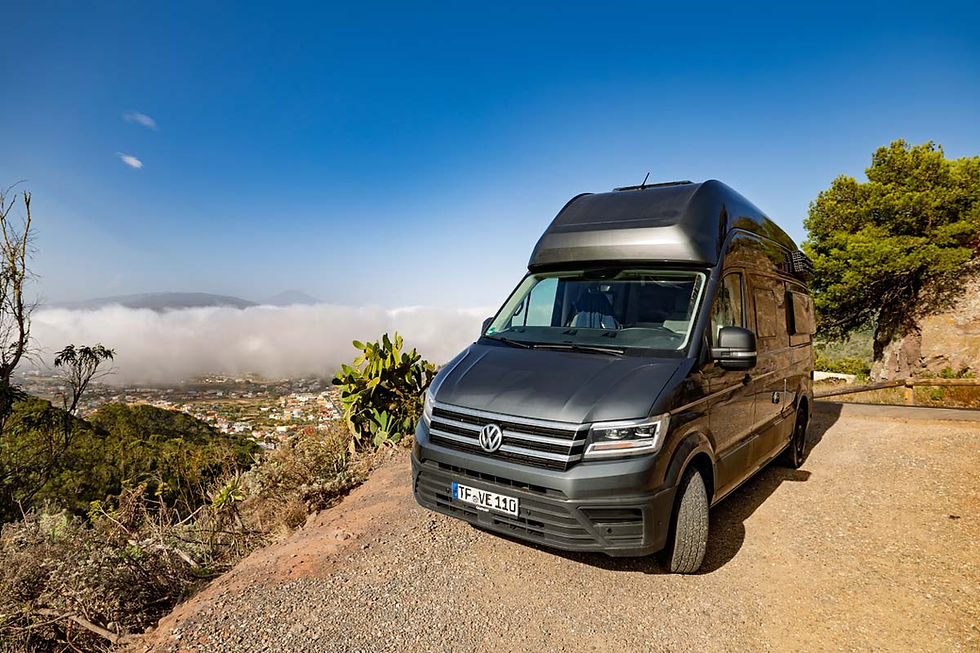
VW Grand California 600: Volkswagen's full motorhome on a modern platform. Fixed rear double bed, full bathroom with shower and toilet, spacious kitchen. The step up from a campervan to a proper home on wheels, without giving up the driving comfort of a VW. The right choice for families or anyone who wants to end each day in genuine comfort.
Find out more: https://www.vanxcapes.com/vw-grand-california-600
VW Grand California 600 with Solar: same premium interior as the Grand California, with a solar panel for extended autonomy off the grid. Particularly useful in Teide National Park, where hook-ups are not available and the sun does the work for you. Independence without compromise.
Find out more: https://www.vanxcapes.com/vw-grand-california-600-with-solar
VW KNAUS Van Wave 640 MEG: twin rear beds, full bathroom, satellite TV, 100-litre fresh water tank. A motorhome built for longer stays and higher comfort expectations. Generous storage for surf and sports equipment. Best on the main routes and campsite nights — the definitive choice for those who travel with more.
Find out more: https://www.vanxcapes.com/knaus-van-wave-640-meg-vw
VW KNAUS Van TI Plus 700 LF Platinum: the flagship of the vanXcapes fleet. Island bed at the rear, rotating captain seats, panoramic windows, separate bathroom, full kitchen, solar panel and 177 hp automatic transmission. At 7.47 metres it is best kept to the main roads, but the experience inside — parked at sunrise in the Teide pine forest — is hard to match. For those who want nothing less than the best.
Find out more: https://www.vanxcapes.com/knaus-van-ti-plus-700-lf-platinium
Practical Tips for Your Campervan Rental in Tenerife
When to go: Tenerife works year-round. The south is warm and dry in every season. The north is greener and cooler, with occasional rain in winter. January and February are excellent: 20-22 degrees in the south, snow possible on Teide above 2,000 metres. Summer is warm but the constant breeze from the northeast keeps El Médano and the east coast comfortable.
Driving: Tenerife South Airport is the main entry point. The TF-1 motorway connects the south to the north quickly. Give yourself extra time on mountain roads — they are safe but slow.
Fuel: diesel in Tenerife costs around 1.00 euro per litre, significantly less than mainland Europe. The Canary Islands have a special tax regime that applies to fuel. Fill up on arrival.
Teide permits: the summit walk above the cable car top station requires a free permit, available online through the Spanish national park authority. Apply weeks in advance in summer.
Supermarkets: well-stocked supermarkets throughout the island. Mercadona and Hiperdino are the main chains. In the Anaga villages, choice is limited — stock up before heading in.
Internet: good 4G coverage across most of the island. The deep Anaga valleys have patchy signal. Teide National Park has limited coverage in places.
Pets: all vanXcapes models welcome pets. Tenerife is dog-friendly outside of protected natural areas. Check the specific rules for Teide National Park before bringing a dog.
Island hopping: all vanXcapes campervans are approved for the ferry crossing from Los Cristianos (south Tenerife) to Morro Jable (Fuerteventura). The crossing takes around 2.5 to 3 hours and runs several times per week. Combining both islands gives you two completely different experiences in a single trip.
Ready for your campervan rental in Tenerife? Check availability and find the right van for your route.
vanXcapes – for vansation seekers.


Comments